suppressPackageStartupMessages({
    library(terra)
    library(sf)
    library(dplyr)
    library(tidyr)
    library(units)
    library(exactextractr)
    library(redlistr)
})11 Subcriteria A2b
Using R with terra package
11.1 Updating the assessment workflow
The original workflow included a combination of two remote sensing products (Friedl et al. 2010; Hansen et al. 2013). The updated workflow is based on an updated version of one data source that spans more years and uses improved algorithms. We have two version of the workflow, one based on R and local copies of the remote sensing products (this chapter), and one based on Python and Earth Engine for cloud computing (see Section 12.1).
Differences between original and updated assessment workflows for subcriterion A2b.
| Step | 2019 | 2025 (R) | 2025 (Python) |
|---|---|---|---|
| GIS data prep. | GRASS GIS / gdal / R |
R / gdal / terra |
Earth Engine |
| Data source | GFC v1.2 (2015) and MODIS LC v5.1 | GFC v1.12 (2024) | GFC v1.12 (2024) |
| Analysis | R / glm |
R / glm / redlistr |
Python / Earth Engine |
| Timeframe | 2000-2050 | 2000-2050 | 2000-2050 |
11.2 Set up
Load packages
We will run this analysis using the following packages in R.
Load data
We start by configuring the relative path to our data folder:
here::i_am("R/subcriterion-A2b.ipynb")
data_dir <- here::here("downloaded-data")
here() starts at /Users/z3529065/proyectos/Forests-Americas/RLE-example-dry-forest-guajira
We already downloaded the vector data for the distribution of the target macrogroup from OSF in Chapter 4, now we read the spatial data in vector format using the function vect from package terra:
M563 <- read_sf(here::here(data_dir,
  "1.A.1.Ei.563---Guajiran-Seasonal-Dry-Forest-1km.gpkg"))
We already downloaded and prepared the GFC data for estimates of tree cover in Chapter 7, now we read the spatial data in raster format using the function rast from package terra.
tif_files <- dir(
  here::here(data_dir,"GFC-2024-v1.12"),
  recursive=TRUE,
  pattern="*tif$",
  full.names=TRUE)

lossyear <- rast( grep("lossyear", tif_files, value=TRUE))
gain <- rast(grep("gain", tif_files, value=TRUE))
cover <- rast(grep("treecover2000", tif_files, value=TRUE))
cover24 <- rast(grep("treecover2024", tif_files, value=TRUE))
A quick check that this is indeed correct:
plot(cover)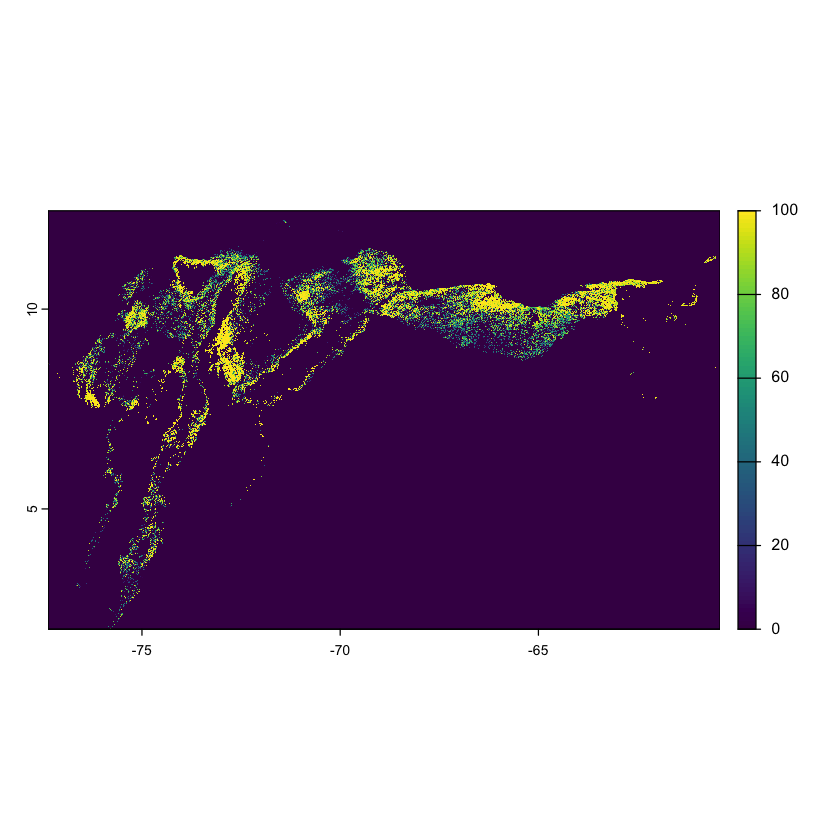
Now make a couple of extra files for the calculations below:
loss <- (lossyear > 0) + 0
initial <- (cover > 0) + 0
Now we bundle these raster files together:
gfc <- c(cover, cover24, initial, gain, loss)
names(gfc) <- c("cover00", "cover24", "initial", "gain", "loss")
The data is in unprojected units, but we can calculate the resolution for each cell:
raster_resolution <- cellSize(loss) raster_resolutionclass : SpatRaster
size : 41880, 67800, 1 (nrow, ncol, nlyr)
resolution : 0.00025, 0.00025 (x, y)
extent : -77.37, -60.42, 1.99, 12.46 (xmin, xmax, ymin, ymax)
coord. ref. : lon/lat WGS 84 (EPSG:4326)
source : spat_102fafb106af_66298_P2mm2aa9P9QX7pk.tif
varname : GFC-2024-v1.12.M563.lossyear
name : area
min value : 751.6660
max value : 768.8654 11.3 Summarise changes
Processing these large raster files in R can be slow, but it is possible to speed up the calculations by using a grid and functions from library exactextractr:
rawgrid <- st_make_grid(M563, cellsize = .091)
grid <- st_sf(id = 1:length(rawgrid), geoms = rawgrid,
        stringsAsFactors = FALSE)
We try with a cell size that is roughly 10 by 10 km in area:
range(set_units(st_area(grid),'km2'))Units: [km^2]
[1] 99.99352 102.32401Ok let’s run this while we get a cup of coffee or glass of water…
qry <- exact_extract(gfc, grid, fun="sum", append_cols = c("id"))Cannot preload entire working area of 14178211740 cells with max_cells_in_memory = 3e+07. Raster values will be read for each feature individually.
|======================================================================| 100%res_gfc <- exact_extract(raster_resolution, grid, fun="mean", append_cols = c("id"),force_df=TRUE)Cannot preload entire working area of 2835642348 cells with max_cells_in_memory = 3e+07. Raster values will be read for each feature individually.
|======================================================================| 100%Ok, we are back and we have some results, now we will try to summarise these per cell.
res_gfc <- res_gfc |> mutate(res=set_units(mean,'m2') |> set_units('km2'))extent_estimates <-
tibble(qry) |> left_join(res_gfc,by='id') |>
filter(sum.initial>0 | sum.gain>0) |>
mutate(cells_2000=sum.initial,
cells_2024=sum.initial + sum.gain - sum.loss,
mean_2000 = (sum.cover00 / 100) / sum.initial,
eco_extent_2000 = cells_2000 * res * mean_2000,
eco_extent_2024 = cells_2024 * res * mean_2000,
alt_extent_2000 = (sum.cover00/100) * res,
alt_extent_2024 = (sum.cover24/100) * res
)head(extent_estimates)| id | sum.cover00 | sum.cover24 | sum.initial | sum.gain | sum.loss | mean | res | cells_2000 | cells_2024 | mean_2000 | eco_extent_2000 | eco_extent_2024 | alt_extent_2000 | alt_extent_2024 |
|---|---|---|---|---|---|---|---|---|---|---|---|---|---|---|
| <int> | <dbl> | <dbl> | <dbl> | <dbl> | <dbl> | <dbl> | <[km^2]> | <dbl> | <dbl> | <dbl> | <[km^2]> | <[km^2]> | <[km^2]> | <[km^2]> |
| 16 | 394338.00 | 368003.00 | 6402.000 | 9 | 367.00000 | 768.8402 | 0.0007688402 [km^2] | 6402.000 | 6044.000 | 0.6159606 | 3.0318291 [km^2] | 2.8622891 [km^2] | 3.0318291 [km^2] | 2.8293550 [km^2] |
| 17 | 210969.00 | 187326.00 | 4873.000 | 1 | 404.00000 | 768.8402 | 0.0007688402 [km^2] | 4873.000 | 4470.000 | 0.4329345 | 1.6220145 [km^2] | 1.4878729 [km^2] | 1.6220145 [km^2] | 1.4402376 [km^2] |
| 18 | 786993.69 | 704305.69 | 13946.496 | 59 | 1257.00000 | 768.8402 | 0.0007688402 [km^2] | 13946.496 | 12748.496 | 0.5642949 | 6.0507239 [km^2] | 5.5309685 [km^2] | 6.0507239 [km^2] | 5.4149853 [km^2] |
| 19 | 69479.45 | 65038.04 | 1124.920 | 1 | 54.67097 | 768.8402 | 0.0007688402 [km^2] | 1124.920 | 1071.249 | 0.6176392 | 0.5341859 [km^2] | 0.5086994 [km^2] | 0.5341859 [km^2] | 0.5000386 [km^2] |
| 205 | 336483.91 | 290286.06 | 5995.497 | 3 | 680.13544 | 768.7968 | 0.0007687968 [km^2] | 5995.497 | 5318.361 | 0.5612278 | 2.5868776 [km^2] | 2.2947139 [km^2] | 2.5868776 [km^2] | 2.2317100 [km^2] |
| 206 | 873585.75 | 764134.00 | 16832.078 | 63 | 1703.53223 | 768.7968 | 0.0007687968 [km^2] | 16832.078 | 15191.546 | 0.5190005 | 6.7160994 [km^2] | 6.0615173 [km^2] | 6.7160994 [km^2] | 5.8746378 [km^2] |
extent_estimates |>
    summarise(
        raw2000=sum(alt_extent_2000),
        raw2024=sum(alt_extent_2024),
        eco2000=sum(eco_extent_2000, na.rm = TRUE),
eco2024=sum(eco_extent_2024, na.rm = TRUE))| raw2000 | raw2024 | eco2000 | eco2024 |
|---|---|---|---|
| <[km^2]> | <[km^2]> | <[km^2]> | <[km^2]> |
| 97390.84 [km^2] | 85126.09 [km^2] | 97390.84 [km^2] | 84968.26 [km^2] |
11.4 Calculate declines
calc_decline <- function(data,start,end) {
  stopifnot("eco_extent" %in% colnames(data),
            "years" %in% colnames(data),
            start<=nrow(data),
            end<=nrow(data))
  start_date <- pull(data[start,"years"])
  end_date <- pull(data[end,"years"])
  stopifnot(start_date<end_date)
  start_extent <- pull(data[start,"eco_extent"])
  end_extent <- pull(data[end,"eco_extent"])
  res <- dplyr::tibble(
    start_date,
    end_date,
    time_frame = end_date-start_date,
    decline = (units::set_units(1,'1') -
                 (end_extent/start_extent)) %>%
      units::set_units('%')
      )
  if ("error_extent" %in% colnames(data)) {
    start_error <- pull(data[start,"error_extent"])
    end_error <- pull(data[end,"error_extent"])
    res$error <- sqrt(((end_extent^2 * start_error^2) + (start_extent^2 * end_error^2)) / (start_extent^4)) %>% units::set_units('%')
  }
  return(res)
}
rslts <- extent_estimates |>
dplyr::select(id,eco_extent_2000,eco_extent_2024) |>
pivot_longer(c(eco_extent_2000,eco_extent_2024),
names_prefix = "eco_extent_",
names_transform = as.numeric,
names_to = "years", values_to="eco_extent") |>
group_by(years) |>
summarise(eco_extent=sum(eco_extent, na.rm = TRUE))rslts| years | eco_extent |
|---|---|
| <dbl> | <[km^2]> |
| 2000 | 97390.84 [km^2] |
| 2024 | 84968.26 [km^2] |
85126.09 / 97390.84
0.874066698675153
DS <- getDeclineStats(drop_units(rslts$eco_extent[1]), drop_units(rslts$eco_extent[2]),
                           year.t1 = rslts$years[1], year.t2 = rslts$years[2],
methods = c('PRD', 'ARD', 'ARC'))DS| absolute.loss | ARD | PRD | ARC |
|---|---|---|---|
| <dbl> | <dbl> | <dbl> | <dbl> |
| 12422.58 | 517.6075 | 0.5669467 | -0.56856 |
y_future <- extrapolateEstimate(drop_units(rslts$eco_extent[1]),
                    year.t1 = rslts$years[1],
                    nYears = 50,
                                  PRD = DS$PRD,
                                  ARD = DS$ARD,
                                  ARC = DS$ARC) |>
tibble()y_future| forecast.year | A.ARD.t3 | A.PRD.t3 | A.ARC.t3 |
|---|---|---|---|
| <dbl> | <dbl> | <dbl> | <dbl> |
| 2050 | 71510.46 | 73292.05 | 73292.05 |
rslts <- bind_rows(
    rslts,
    {transmute(y_future,
        eco_extent=set_units(A.ARD.t3,'km2'),
        years=forecast.year) },
    {transmute(y_future,
        eco_extent=set_units(A.PRD.t3,'km2'),
        years=forecast.year) },
    {transmute(y_future,
        eco_extent=set_units(A.ARC.t3,'km2'),
years=forecast.year) })calc_decline(rslts,1,2:5)| start_date | end_date | time_frame | decline |
|---|---|---|---|
| <dbl> | <dbl> | <dbl> | <[%]> |
| 2000 | 2024 | 24 | 12.75539 [%] |
| 2000 | 2050 | 50 | 26.57373 [%] |
| 2000 | 2050 | 50 | 24.74441 [%] |
| 2000 | 2050 | 50 | 24.74441 [%] |
st_area(M563) |> set_units('km2')253656.4 [km^2](st_area(M563) |> set_units('km2') / (105206342 + 54502069 + 233854))0.001585924 [km^2]97390.84 /1.5
64927.2266666667